
LOCAL GOVERNMENT AND MUNICIPALITIES
Moving from crisis response to dependable service delivery.
When water systems fail, the impact is immediate and visible — from unsafe supply, to community anger, regulatory scrutiny, and service-delivery protests. Municipalities sit at the frontline of public accountability.
Kalabas gives municipalities a practical way to add capacity, stabilise performance, and improve water quality without shutting down existing systems or committing to multi-year rebuilds.
Parallel installation
New capacity added alongside existing plants — no shutdowns, no extended service interruptions.
Rapid deployment
Months to operation, not years — enabling faster response to service-delivery failures.
Lower CAPEX and OPEX
Reduced energy, chemical, and maintenance costs aligned with municipal budget realities.
No derating under variability
Maintains output and water quality even under extreme turbidity and seasonal variability.
Scalable capacity
Add water capacity incrementally as demand and budgets allow.
The operating reality municipalities are managing
Local municipalities are responsible for delivering safe, reliable water services in an environment of growing demand, ageing assets, and increasingly variable source water quality. Many treatment works are operating close to their design limits, while others must work harder than originally intended to meet current service requirements.
Seasonal pressure
During heavy rainfall, raw-water quality can deteriorate rapidly — placing additional load on treatment processes precisely when communities need maximum reliability.
Energy instability
Load-shedding compounds the challenge, reinforcing the need for systems that maintain performance under fluctuating energy conditions.
Budget constraints
Long procurement cycles and multi-year upgrade projects delay relief even when funding and intent are in place.
Skills scarcity
Chronic shortages of skilled operators mean systems need to run reliably with minimal specialist intervention.
Adding capacity without shutting systems down
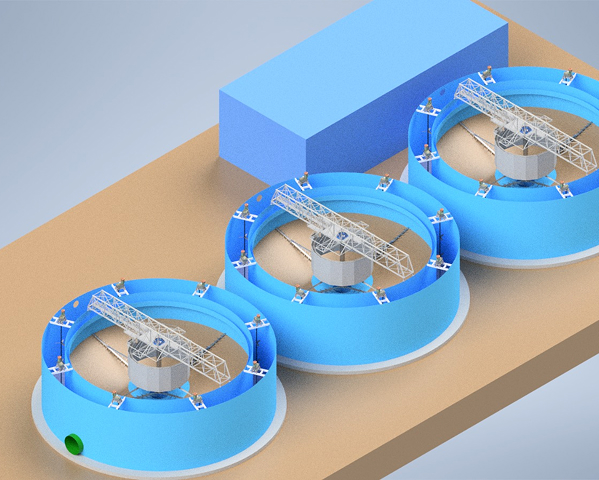
Kalabas installs in parallel to existing treatment works. This allows municipalities to increase capacity and improve water quality without taking plants offline or exposing communities to extended outages during construction.
"Instead of dismantling and rebuilding, Kalabas supplements what is already in place — stabilising supply while longer-term planning continues."
Delivering visible results on municipal timelines
Traditional water infrastructure upgrades often take four to six years — timeframes incompatible with service-delivery pressure. Kalabas can be deployed in roughly ten months, allowing municipalities to respond meaningfully to community needs.
~10 mo
Contract to operation
4–6 yr
Conventional timeline
50 MLD
Delivered at Hammanskraal
This speed matters. It restores confidence, reduces protest risk, and demonstrates action rather than intent.
Operating within constrained municipal budgets
Kalabas reduces both capital and operating expenditure. Its integrated design lowers energy consumption, chemical usage, and maintenance complexity. Eliminating large dedicated sedimentation tanks reduces upfront cost, while fewer equipment components mean lower ongoing maintenance and spare-parts requirements.
Conventional plant
- 100–150 kW per megalitre
- Standard chemical dosing
- 10–15% water loss
- Manual or semi-manual operation
- Multiple separate structures
Kalabas
- <50 kW per megalitre
- ~50% less coagulant
- <5% water loss
- Fully automated operation
- Single integrated module
Built for deteriorating source water
As wastewater treatment plants fail and catchments degrade, raw-water quality becomes increasingly unpredictable. Kalabas is designed to maintain performance under these conditions — handling turbidity levels exceeding 400 NTU without reducing output, where conventional plants are often forced to cut capacity by up to 40%.

Simplifying operations where skills are scarce
Many municipalities face chronic shortages of skilled operators. Kalabas addresses this directly through a fully automated operating system that reduces dependence on highly specialised staff. With fewer equipment types, simplified maintenance, and continuous operation without backwashing downtime, plants are easier to manage day-to-day.
Local 24/7 support ensures issues are resolved quickly, without reliance on offshore service centres.
From emergency intervention to permanent solution
In Hammanskraal, Kalabas was initially deployed as an emergency, mobile intervention. Its performance and reliability led to it becoming the permanent extension of the system rather than a temporary fix. With an expected lifespan of approximately 25 years, Kalabas provides long-term water security rather than short-term relief.
"The 'temporary' solution outperformed the infrastructure it was meant to support — and became the permanent extension instead."